Complex Acne Scars Protocols

Not a depth problem — a biological sequencing problem. Topography first. Graduated chemical signaling. Metabolic consolidation. Dermal stretching when needed.

  • Topography before intensity (avoid single-tool escalation).
  • Graduated chemical photodetersion instead of an isolated CROSS reflex.
  • Deep metabolic signaling (α-lipoic + metabolic peels) for consolidation.

Clinical framework for physicians & trained professionals. Not a before/after gallery.
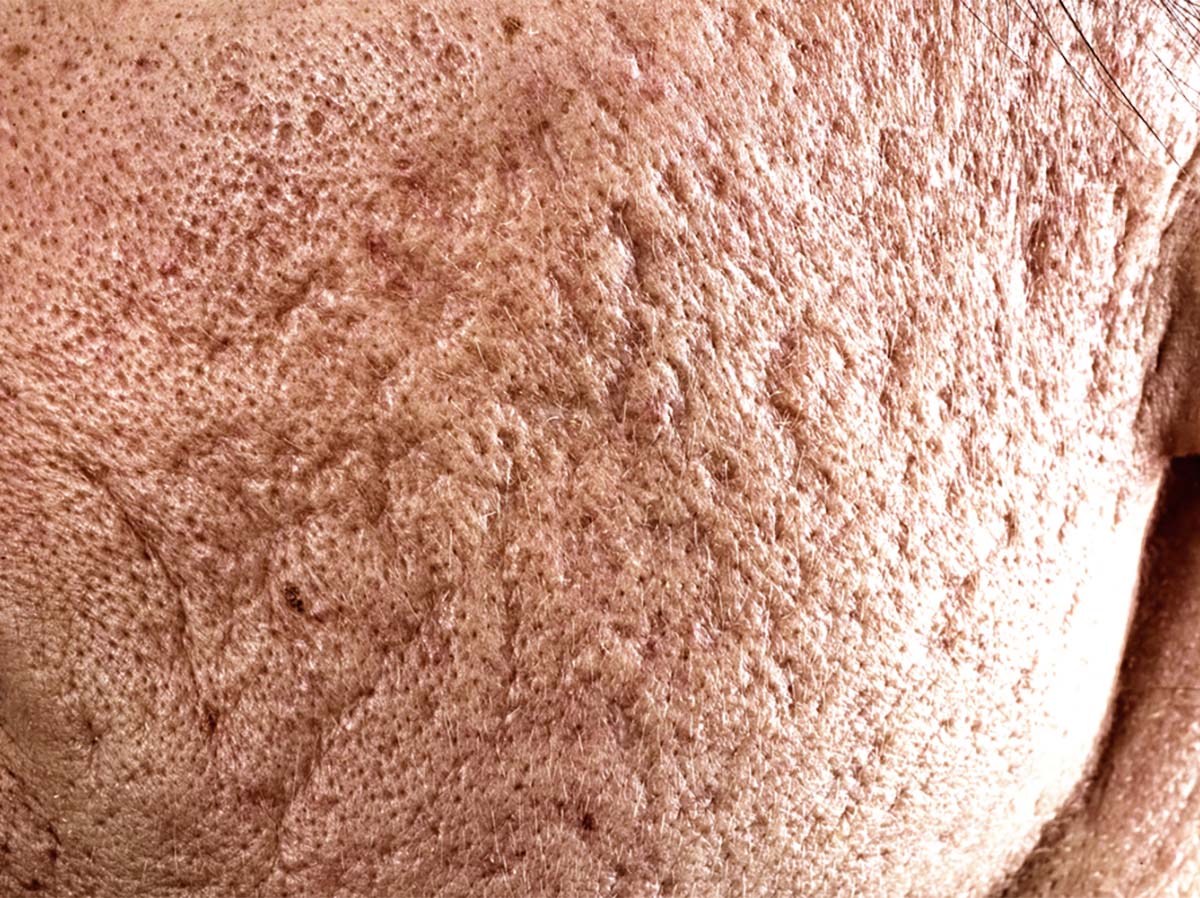
Deep post-acne scarring with mixed atrophic patterns; clinical texture contrast typical after inflammatory acne
Deep acne scars: complex relief + texture contrast (typical clinical pattern).

Typical Background (Very Common Case)

A reproducible clinical pattern: multiple prior interventions, persistent atrophic scars, dermal fibrosis, and a visible texture contrast between scar tissue and surrounding skin. This page is designed as a clinical decision framework (not a before/after gallery).

Typical history

  • Inflammatory acne history (often long-standing).
  • Prior resurfacing procedures (e.g., fractional CO₂ laser).
  • Subcision for tethered scars.
  • Dermal fillers (e.g., hyaluronic acid) to reduce depth perception.

Despite these interventions, patients frequently remain with a mixed atrophic pattern and persistent “surface-to-scar” discontinuity.

What typically remains

  • Complex atrophic scars (often mixed patterns, not only “ice-pick”).
  • Dermal fibrosis and reduced skin elasticity.
  • Texture contrast between scarred and non-scarred skin.
  • Uneven response to repeated aggressive procedures.
Clinical takeaway: the key question is rarely “how deep?” but how to sequence signals (topography, chemistry, metabolism, and dermal tension) to achieve a stable, predictable remodeling.

Why Single-Tool Thinking Fails in Complex Acne Scars

Depth alone does not reorganize tissue. Repeated escalation without biological sequencing often stabilizes contrast instead of improving structure.

1. Isolated TCA-CROSS Escalation

CROSS is effective for true ice-pick scars, but when applied as a dominant strategy, it treats depth without addressing surface contrast or global dermal quality.

  • Improves focal pits.
  • Does not homogenize the overall relief.
  • May increase contrast between treated and untreated areas.

2. Aggressive Resurfacing Without Sequencing

Increasing laser depth or TCA concentration without structured intervals often ignores the metabolic capacity of the tissue.

  • Short-term smoothing may occur.
  • Fibrosis and texture contrast can persist.
  • Remodeling remains incomplete.

3. Ignoring Metabolic Consolidation

Mechanical or chemical interventions without metabolic signaling leave the dermis partially reorganized.

  • No structured α-lipoic signaling.
  • No interval remodeling strategy.
  • No tension rebalancing when needed.

Core Principle: Biological Signal Hierarchy

Complex post-acne scars are rarely a simple “depth problem”. They represent a mismatch between topography, chemical signaling, dermal metabolism and tissue tension. Successful treatment depends on the correct sequencing of these signals.

Modern dermatology often stacks techniques. Effective remodeling requires structured biological sequencing.

1. Mechanical / Laser Leveling

Superficial homogenization of relief. Reduces contrast before deeper signaling.

2. Graduated Chemical Photodetersion

Structured TCA distribution (18–15–12%) instead of isolated depth escalation.

3. Deep Metabolic Signaling

α-lipoic support, metabolic peels, interval-based remodeling.

4. Dermal Tension Rebalancing

Stretching strategies (e.g., Endopeel) to restore structural dynamics.

Key message: This is not a question of which tool is stronger. It is a question of which biological signal should be delivered first — and how the following signals are sequenced.

Four Structured Approaches in Complex Acne Scars

Each protocol has a specific indication. The key difference is not intensity, but how relief, chemistry, metabolism and dermal tension are sequenced.

Protocol 1
Classical TCA-CROSS Based

Focal correction of true ice-pick scars with optional light full-face TCA.

  • Precise depth targeting
  • Technically well established
  • Max. 2–3 sessions

Limitation: does not homogenize global texture contrast.

Detailed protocol →

Protocol 2
Sushi Peel (Er:YAG + TCA)

Homogenization before focal escalation. Laser leveling + graduated TCA (18–15–12%).

  • Immediate relief homogenization
  • Reduced scar/skin contrast
  • Uniform chemical absorption base
  • Lower PIH risk through distribution

Max. 3 weekly sessions, then consolidation.

Detailed protocol →

Protocol 3
Chemodermabrasion

Mechanical + chemical leveling of topography.

  • Direct surface equalization
  • Ideal preparation for metabolic peels
  • Scientifically coherent approach

Underused today, but historically logical.

Detailed protocol →

Protocol 4
Endopeel + Metabolic Peels

Dermal tension rebalancing before or during peeling strategy.

  • Deep dermal stretching
  • Improved global skin tension
  • Reduced cratered appearance

Structural optimization rather than surface-only correction.

Detailed protocol →

Protocol 1 – Classical TCA-CROSS Strategy

Designed for true ice-pick scars with optional controlled full-face TCA support. The objective is focal depth correction while maintaining metabolic stability.

Phase 1 – Pre-treatment (7–10 days)

  • Aseptiskin – 2× daily (microbiome stabilization & barrier normalization)
  • PrePeel (α-lipoic) – 1× daily (penetration priming & metabolic activation)

Phase 2 – Procedure Day

  • TCA-CROSS strictly focal on true ice-pick scars
  • Optional light full-face TCA 18% (controlled)
  • Peeling Deluxe Plus immediately post-application (reaction harmonization & distribution control)

Phase 3 – Post-procedure (Days 1–7)

Metabolic signaling note:
Throughout this protocol, redox modulation plays a central role. Alpha-lipoic acid is used as a metabolic cofactor to support mitochondrial activity, regulate oxidative signaling, and optimize dermal remodeling between procedural sessions.

Protocol 2 – Sushi Peel (Er:YAG + Graduated TCA Photodetersion)

This protocol prioritizes relief homogenization before focal chemical escalation. It reduces texture contrast, creates a uniform absorption substrate, and distributes the biological stimulus in a controlled manner.

Phase 1 – Pre-treatment (7 days)

  • Aseptiskin – 2× daily
  • PrePeel – 1× daily (penetration priming)

Phase 2 – Procedure

  • Superficial Er:YAG full-face pass (relief leveling)
  • Graduated TCA distribution:
    • 18% on lesional zones
    • 15% peri-lesional
    • 12% transition zones
  • Peeling Deluxe Plus applied immediately post-frosting
From the second session onward, controlled TCA frosting on crusts is therapeutically intentional and not secondary.

Session Frequency

  • 1 session per week
  • Maximum 3 sessions total
  • No extension beyond biological tolerance

Post-procedure (Days 1–7)

  • Stretchpeel – mornings (photoprotection)
  • LesFélins – 3–5× daily hydration

Metabolic Consolidation

Structured redox modulation is maintained between sessions. Alpha-lipoic acid acts as a metabolic cofactor, supporting mitochondrial activity and optimizing dermal remodeling.

Why this protocol is often more rational than isolated CROSS:
  • Immediate homogenization of relief
  • Reduction of scar/healthy skin contrast
  • Creation of a uniform chemical absorption substrate
  • Reduced PIH risk through controlled distribution of aggression

Protocol 3 – Chemodermabrasion (Mechanical + Chemical Leveling)

Chemodermabrasion directly addresses topography. Unlike purely chemical escalation, it combines controlled mechanical leveling with chemical modulation, creating a uniform remodeling base.

Phase 1 – Pre-treatment (7–10 days)

  • Aseptiskin – 2× daily
  • PrePeel – 1× daily (penetration preparation)

Phase 2 – Procedure

  • Controlled mechanical dermabrasion of irregular zones
  • Integrated chemical modulation (TCA adapted to topography)
  • Peeling Deluxe Plus post-procedure for reaction harmonization
The objective is surface equalization first — not depth escalation.

Session Frequency

  • Usually one primary session
  • Re-evaluation at 6–8 weeks
  • Metabolic peels thereafter every 2–4 weeks

Post-procedure Support

  • Stretchpeel – mornings (structured photoprotection)
  • LesFélins – 3–5× daily during re-epithelialization

Structured redox modulation, including alpha-lipoic acid support, optimizes dermal reorganization during the consolidation phase.

Why is chemodermabrasion underused today?
  • Medico-legal caution
  • Loss of technical training culture
  • Shift toward “device-driven” plug-and-play solutions

Scientifically, however, it remains one of the most coherent approaches for complex post-acne topography when performed in a structured framework.

Protocol 4 – Endopeel + Metabolic Peels

Endopeel is not a scar treatment in the narrow sense. It is a structural strategy designed to restore dermal tension, improve mechanical dynamics, and optimize the biological response before or during peeling protocols.

Indication Logic

  • Global loss of dermal tension
  • Cratered appearance with mechanical collapse
  • Insufficient response to repeated resurfacing

Structural Effects

  • Deep dermal stretching
  • Improved global skin tension
  • Reduction of crater perception through tension redistribution
  • Restoration of favorable tissue dynamics
The objective is not surface aggression, but structural rebalancing.

Session Strategy

  • Usually one Endopeel session
  • Re-evaluation at 4–6 weeks
  • Metabolic peels every 2–4 weeks if indicated

Integrated Support

  • Aseptiskin – barrier normalization
  • PrePeel – metabolic priming
  • Stretchpeel – structured photoprotection
  • LesFélins – hydration & barrier reinforcement

Alpha-lipoic acid–based redox modulation supports dermal remodeling during the consolidation phase.

Further reading:
Detailed Endopeel indications and structural rationale can be found here:

View Endopeel Acne Scar Indications →

Unified Product Sequencing Across All Protocols

Regardless of whether the chosen strategy is TCA-CROSS, Sushi Peel, Chemodermabrasion, or Endopeel integration, the biological support structure remains consistent.

Step 1 – Pre-Conditioning (7–10 days)

  • Aseptiskin – barrier & microbiome stabilization
  • PrePeel – penetration priming

Step 2 – Procedure Day

  • Selected mechanical / chemical intervention
  • Peeling Deluxe Plus post-procedure reaction harmonization

Step 3 – Early Recovery (Days 1–7)

  • Stretchpeel – structured photoprotection
  • LesFélins – intensive hydration & barrier reinforcement

Step 4 – Metabolic Consolidation

  • Metabolic peels every 2–4 weeks
  • Redox modulation including alpha-lipoic acid support
  • Interval-based dermal remodeling
Core Concept:
The intervention (laser, TCA, mechanical leveling, or dermal stretching) changes according to indication. The biological support architecture does not.

Clinical Decision Framework

In complex post-acne scars, the decisive question is not “How deep should I go?” but “What is the dominant biological limitation?”

If contrast dominates

Visible difference between scar and surrounding skin → Protocol 2 (Sushi Peel)

If topography is irregular

Surface unevenness with mixed scar patterns → Protocol 3 (Chemodermabrasion)

If focal depth dominates

True ice-pick scars requiring precise targeting → Protocol 1 (TCA-CROSS)

If tension loss dominates

Global dermal collapse or cratered appearance → Protocol 4 (Endopeel Integration)

Foundational Principle:
Mechanical leveling, graduated chemical signaling, metabolic consolidation and dermal tension rebalancing are not competing techniques. They are sequential biological signals.

The outcome depends on hierarchy — not intensity.

What Not To Do in Complex Acne Scars

Certain patterns of management may temporarily increase intervention intensity, but do not improve long-term structural remodeling.

Repeating the Same Aggression

Increasing TCA concentration or laser depth repeatedly without structural interval remodeling may stabilize contrast rather than reduce it.

Ignoring Topography

Treating depth without homogenizing the surface leaves visible scar-to-skin contrast unresolved.

Overusing Occlusive Recovery Products

Excessive occlusion may increase local heat retention and does not actively contribute to dermal restructuring.

Extending Sessions Beyond Biological Tolerance

More sessions do not equal better remodeling. Beyond 2–3 structured interventions, the focus should shift toward metabolic consolidation.

Core Reminder:
Complex acne scars do not respond to intensity alone. They respond to structured biological sequencing.

When the hierarchy of signals is respected, aggression becomes precision.

Post-Procedure Recovery: Structural vs Passive Support

After resurfacing or chemical remodeling, recovery must be managed with a clear distinction: comfort and barrier support are useful, but they are not equivalent to active dermal remodeling. In complex acne scars, confusing these roles often delays or limits the final outcome.

1) Passive Occlusion

Occlusive barriers can reduce transepidermal water loss (TEWL) and improve comfort. However, excessive occlusion may retain heat, increase local maceration, and provides no active signal for dermal restructuring.

2) Surface-Only Hydration

Emollients and superficial hydrators are valuable for tolerance, dryness and tightness. Their action remains largely epidermal, which is helpful for comfort but should not be mistaken for deep remodeling.

3) Active Metabolic Support

Complex scars benefit from structured metabolic consolidation between sessions. Redox modulation — including alpha-lipoic acid support — helps optimize oxidative signaling, supports mitochondrial function, and can improve the quality of interval-based dermal reorganization.

Practical takeaway:
Use comfort measures when needed — but do not let passive recovery replace the structured remodeling phase. In complex acne scars, outcomes depend on sequencing, consolidation, and the hierarchy of biological signals.

Integrated Biological Sequencing

Complex acne scars are not a simple “depth problem”. They are the visible result of topographic discontinuity, dermal fibrosis, altered tissue dynamics, and incomplete remodeling after repeated interventions.

The clinical outcome does not primarily depend on choosing the strongest tool. It depends on delivering the right biological signal at the right time: leveling first, then graduated chemical stimulation, then metabolic consolidation — and tension rebalancing when indicated.

Final statement:
This is not a question of tools. It is a question of hierarchy — the hierarchy of biological signals.

Share this website on your social medias